DSCR Loan Rates: The Adjustments That Move Your Number
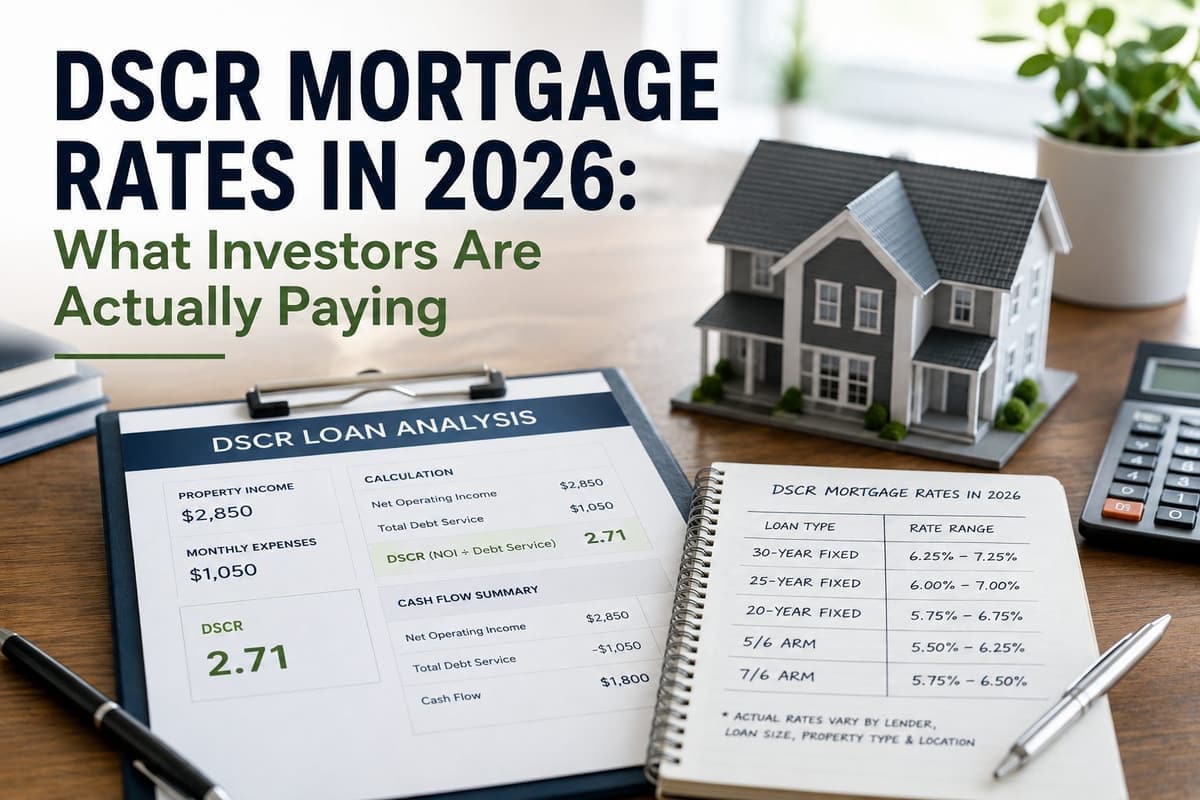
There is no such thing as "the" DSCR rate. There is a base rate, and then there is a stack of adjustments that gets added to it based on seven or eight things about your specific deal.
Two investors can call the same lender on the same morning and get quotes 1.5 points apart. Neither was lied to. They had different files.
Understanding the stack is what lets you change your quote instead of just shopping it.
Compare structures for your deal: DSCR loan programs · Model your payment
Where DSCR rates sit relative to everything else
DSCR loans price above conventional financing. The spread is real and it is the cost of not documenting income.
Roughly, in order of price:
- Owner-occupied conventional — the cheapest money in the market
- Conventional investment property — typically 0.5-0.875% above owner-occupied
- DSCR — commonly 1.0-2.5% above conventional investment
- Bridge and hard money — several points above that
If you can qualify conventionally on a 1-4 unit and you are under the ten-property limit, conventional is usually cheaper. DSCR earns its premium in three situations: your tax returns do not show the income, you are past the conventional property count, or you need to close in an entity without a personal income story.
That is the honest framing. A broker who tells you DSCR is always better is selling you the product they have.
The adjustment stack
Lenders publish a base rate, then add or subtract in increments — usually quarter-points of rate or fractions of a point in fee. Here is what is in the stack, in rough order of how much it moves.
1. The DSCR ratio itself
| Ratio | Typical pricing effect |
|---|---|
| 1.25+ | Best tier, no add |
| 1.15 – 1.24 | Small add |
| 1.00 – 1.14 | Moderate add |
| 0.75 – 0.99 | Large add, LTV usually capped near 70% |
| No-ratio | Largest add, lowest leverage |
This is the biggest single lever, and the one most within your control — because the ratio moves when the payment moves, and the payment moves when the down payment moves.
2. Credit tier
Bands typically break at 680, 700, 720, 740 and 760. The steps are not even. On many sheets, the jump from 699 to 700 is worth more than the jump from 740 to 760.
If you are sitting at 697, that is worth knowing before you lock.
3. Leverage
75% LTV prices better than 80%. 70% better than 75%. The break points are usually 5% apart, and crossing one in the right direction can be worth more than the extra cash costs you.
Worth running: if dropping from 80% to 75% LTV saves half a point in rate, on a $300,000 loan that is roughly $1,500 a year against $15,000 more cash in. Whether that trade is good depends entirely on what else you would do with the $15,000.
4. Loan purpose
Purchase prices best. Rate-and-term refinance is close. Cash-out is the expensive one — commonly a meaningful add, and it comes with the lower LTV cap on top.
5. Property type
Single-family detached is the baseline. Add for 2-4 units, add for condos, add more for non-warrantable condos. Rural designations add or make the file ineligible.
6. Occupancy and rental type
Long-term rental is the baseline. Short-term rental typically adds, and the add varies more between lenders than almost any other line — some price STR near LTR, some add a full point, some decline it. This is the single strongest argument for brokering an STR deal rather than going direct.
7. Prepayment penalty term
This one runs backward from the others: accepting a longer penalty lowers your rate.
| Prepay structure | Rate effect |
|---|---|
| 5-year step-down (5/4/3/2/1) | Lowest rate |
| 3-year | Moderate add |
| None | Largest add, often 0.5-1.0% |
Match this to your hold period, not to your preference for flexibility. A five-year penalty on a property you will own for fifteen years is free money. The same penalty on a property you plan to refinance in eighteen months can cost several times what the rate saved.
8. Loan amount
Small loans carry a penalty. Under roughly $150,000, many lenders add — the fixed cost of originating does not scale down. Some set a hard floor around $75,000-$100,000.
Very large loans can also add, depending on the program.
9. First-time investor
Some programs add for a borrower with no prior rental ownership. Others do not care at all. Worth asking directly rather than assuming.
Points versus rate
You will usually be offered a grid — pay more in points now, take a lower rate.
The math is simple and people still get it wrong. Divide the cost of the points by the monthly savings to get the break-even in months. Then ask honestly how long you are keeping the loan.
On a $300,000 loan, one point is $3,000. If it buys 0.25% in rate, that is roughly $47 a month. Break-even lands around 64 months. If your realistic hold is five years, you are paying $3,000 to save $2,800.
Investors systematically overestimate how long they will hold a specific loan. Rental property gets sold, refinanced, 1031'd into something else. Use your actual track record, not your intention.
What you cannot negotiate, and what you can
Cannot move: the base rate. It comes off capital markets and moves daily with the broader bond market. Nobody at the lender is choosing it.
Can move:
- Your ratio — more down, or a property with better rent-to-price
- Your credit tier — see below
- Your LTV band — crossing 75% or 70% in the right direction
- Your prepay term — matched honestly to your plan
- Which lender sees the file — this is the whole argument for a broker, and it matters most on the unusual files: STR, non-warrantable condo, 5-10 unit, foreign national
The credit tier is the fastest lever
If you are within a few points of a break, it is often movable in 30-45 days:
- Pay down revolving utilization. Under 30% helps, under 10% helps more. This is the fastest-moving factor on a score.
- Do not close old cards. Average age of accounts matters.
- Ask about a rapid rescore. If you pay down a balance, a lender can often push the update through in days rather than waiting a cycle.
- Do not open anything new while a file is in process.
Moving 697 to 705 before you lock can be worth more than a week of shopping.
Locks
Rate locks typically run 30, 45 or 60 days. Longer costs more.
Two things investors get caught by:
- Extensions are not free. If your close slips, expect to pay for the extension, priced in fee.
- Material changes can reprice the lock. If the appraisal comes in low and your LTV moves up a band, or the lease comes in under the 1007 and your ratio drops a tier, the lock does not protect you from the adjustment. The lock protects the base rate, not your file's profile.
Lock when the file is complete enough that nothing material is still unknown.
A worked comparison
Two investors, same $400,000 Austin duplex, same day.
| Investor A | Investor B | |
|---|---|---|
| Credit | 762 | 681 |
| Down payment | 25% | 20% |
| DSCR | 1.31 | 1.06 |
| Purpose | Purchase | Cash-out refi |
| Rental type | Long-term | Short-term |
| Prepay | 5-year step-down | None |
Investor A takes essentially the base rate. Investor B is carrying adds on credit, leverage, ratio, purpose, occupancy type and prepay — six lines of the stack, all in the wrong direction.
The gap between them is not a shopping failure. It is six structural decisions, most of which Investor B could have changed before applying.
Illustrative comparison. Actual pricing varies by lender, market conditions and file specifics.
Frequently asked questions
What are DSCR loan rates right now? They move daily with the bond market, and your specific quote depends on the adjustment stack above. Anyone quoting a single number without knowing your ratio, credit, LTV and prepay term is quoting a teaser. Ask for a scenario-specific quote.
Why are DSCR rates higher than conventional? You are not documenting personal income, and the loans are not sold to Fannie Mae or Freddie Mac. That combination prices higher. The premium is commonly 1.0-2.5% over conventional investment property financing.
Can I buy down a DSCR rate? Yes, with points. Run the break-even against your realistic hold period rather than your intended one.
Does accepting a prepayment penalty lower my rate? Yes, usually meaningfully. A 5-year step-down prices better than a 3-year, which prices better than none. The trade is only good if you actually hold that long.
Do short-term rentals get worse rates? Usually, and the add varies enormously between lenders — more than any other factor. Some are near parity with long-term rentals, some add a full point, some will not lend. Worth shopping hard.
Will more money down lower my rate? Two ways at once: it moves you into a better LTV band, and it lowers the payment, which raises your DSCR into a better ratio band. Extra down payment on a DSCR loan often buys more than it would conventionally.
Next steps
The stack is the point. Before you shop rate, look at which of the nine lines you can still change — ratio, credit tier, LTV band and prepay term are all movable before application, and none of them are movable after you lock.
Have a deal you want looked at?
Send the property and the numbers — we shop it across lender programs and tell you honestly whether it works.
Talk To A Loan OfficerRelated Reading
Educational content, not a commitment to lend or an offer of credit. DSCR and fix-and-flip loans are business-purpose loans secured by non-owner-occupied property. Program parameters vary by lender and change over time. Figures are illustrative.