DSCR Loan Down Payment: Total Cash to Close, Line by Line
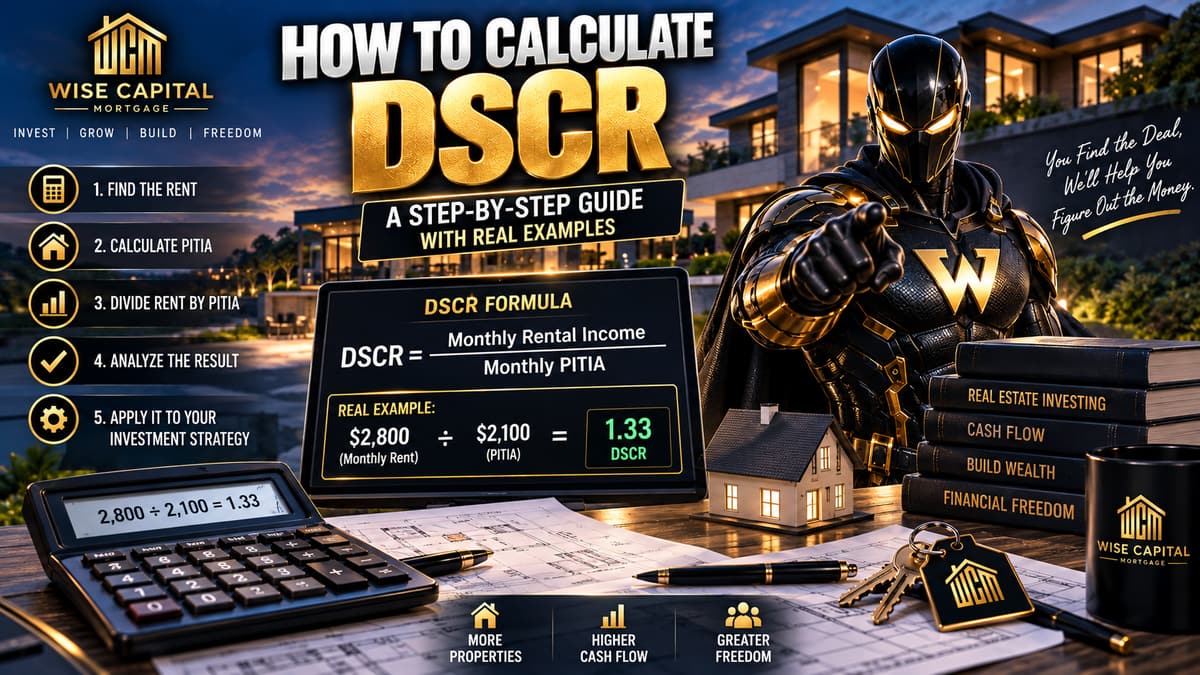
Most investors budget the down payment and get surprised by everything else.
Down payment is one of four separate cash requirements on a DSCR loan. Miss any of the other three and you are not closing, regardless of how solid the property is.
This is the full worksheet.
Start here: DSCR loan programs · Model your payment
The four buckets
| Bucket | Typical size | When it is needed |
|---|---|---|
| Down payment | 20-25% of price | At closing |
| Closing costs | 2-5% of loan | At closing |
| Prepaid escrows | 3-14 months of taxes + insurance | At closing |
| Post-close reserves | 3-6 months PITIA | Held after closing |
The fourth bucket is the one that ends deals. Reserves are not money you spend — they are money the lender verifies you still have when the dust settles. An investor who brings exactly enough to close has, by definition, zero reserves.
Bucket one: the down payment itself
20-25% is the standard band on a purchase.
What moves you inside it:
- 80% LTV (20% down) — needs strong credit, typically 720+, and a DSCR comfortably above 1.00
- 75% LTV (25% down) — the reliable middle. Most deals land here.
- 70% LTV (30% down) — where you end up with a sub-1.00 ratio, a 2-4 unit, a condo, or credit under 680
Stack two weak factors and you drop a band. A 660 score and a 0.95 ratio will not get 80%, no matter how good the property looks.
Refinances run tighter. Rate-and-term typically caps at 75%. Cash-out typically caps at 70-75%, and cash-out usually carries a seasoning requirement — commonly 3-6 months of ownership before the lender will use the new appraised value instead of your purchase price.
Bucket two: closing costs
Budget 2-5% of the loan amount. On a $300,000 loan that is $6,000-$15,000.
What is in it:
- Origination and points — typically 1-2% combined, sometimes more on smaller loans
- Appraisal — $600-$1,200 for residential. Add $200-$400 if a Form 1007 rent schedule is ordered separately, which it usually is.
- Title insurance and settlement — varies by state. In Texas, title rates are promulgated, so this line is predictable and not negotiable between title companies.
- Recording, transfer, doc prep — a few hundred
- Legal or entity review — some lenders charge for reviewing your LLC docs
Texas note: because title premiums are set by the state, shopping title here saves you nothing. Shop the lender and the origination side instead.
Bucket three: prepaid escrows
This one gets missed constantly because it is not a "cost" — it is your own money going into an escrow account.
- Property taxes — often 3-8 months collected up front, depending on where you close relative to the tax year
- Insurance — the full first-year premium, paid at closing, plus 2-3 months into escrow
In Central Texas this bucket is large. On a $400,000 property at a 2% effective rate, annual taxes run roughly $8,000. Six months collected is $4,000 — before you have paid a single month of the actual mortgage.
Texas insurance has also moved sharply. A quote you pulled three months ago may not be the quote you get at closing.
Some DSCR programs allow escrow waivers at lower LTVs, which reduces this bucket but means you are responsible for writing the tax check yourself. That is a cash-flow decision, not a savings.
Bucket four: reserves
3-6 months of PITIA on a single property. 6-12 months if you are financing multiple properties or the property is a short-term rental.
Note that reserves are calculated on PITIA, not P&I. On a $2,400 total payment, six months is $14,400 sitting in an account after you close.
What counts:
- Checking and savings — fully
- Brokerage accounts — often at 70-90% of value
- Retirement accounts — commonly 50-70% of the vested balance, and some lenders require you to be eligible to withdraw
- Business accounts — yes, if you can document your ownership
What does not count: the down payment, closing funds, or equity in other property.
A real worksheet
$400,000 duplex in Round Rock, 75% LTV, long-term rental.
| Line | Amount |
|---|---|
| Purchase price | $400,000 |
| Down payment (25%) | $100,000 |
| Loan amount | $300,000 |
| Origination + points (1.5%) | $4,500 |
| Appraisal + 1007 | $1,300 |
| Title, settlement, recording | $3,200 |
| Prepaid taxes (6 mo @ $667) | $4,000 |
| Insurance (12 mo + 3 escrow) | $3,400 |
| Cash at closing | $116,400 |
| Reserves held after (6 × $2,450) | $14,700 |
| Total liquidity needed | $131,100 |
The down payment was $100,000. The deal needed $131,100. That 31% gap between "the down payment" and "what this actually takes" is the single most common budgeting error in investor financing.
Illustrative. Your taxes, insurance, title and lender costs will differ.
Where the money can come from
DSCR lenders are more flexible than conventional here, because there is no DTI calculation to disturb.
Generally fine:
- Personal savings and checking
- Business or LLC accounts you own
- 1031 exchange proceeds — common and clean, but the timing is rigid. Your 45-day identification and 180-day closing windows have to line up with the loan, and the qualified intermediary has to be in the loop early.
- HELOC or cash-out on another property — allowed by most DSCR lenders. This is a real advantage: conventionally, the new HELOC payment would hit your DTI. On a DSCR loan there is no DTI to hit. The new payment only matters if it is on the subject property.
- Partner or member contributions into the LLC — document the contribution and the operating agreement
- Gift funds — many programs allow them; expect a gift letter and a paper trail
Usually not:
- Seller carrying the down payment as a second lien — most programs prohibit secondary financing on the down payment
- Unsecured personal loans taken out during the process
- Cash deposits you cannot source
Sourcing and seasoning
This is where files stall.
Lenders typically want 60 days of statements on every account you are drawing from. They are looking for two things: that the money is yours, and that it did not arrive as an undisclosed loan.
Rules that save you trouble:
- Move money early. If funds are scattered across four accounts, consolidate them 60+ days before you apply. Otherwise you are documenting four trails instead of one.
- Large deposits need a story and a document. Anything meaningfully outside your normal pattern gets asked about. A property sale needs the settlement statement. A gift needs the letter and the donor's withdrawal. "That was from a friend" fails.
- Cash deposits are the hardest. Physical cash generally cannot be sourced to a lender's satisfaction. If you deal in cash, deposit it and let it season well beyond 60 days.
- Crypto has to be converted and seasoned. Most lenders will not count an exchange balance directly. Liquidate to a bank account and document the transaction history.
Reducing the cash requirement
Legitimate levers, roughly in order of usefulness:
- Buy better. A property with stronger rent-to-price supports a higher ratio, which supports higher leverage. This does more than any financing trick.
- Fix the ratio before you apply. If a slightly lower loan amount moves you from 0.98 to 1.03 DSCR, you may unlock a better LTV band — and end up needing less total cash despite the larger down payment. Run both.
- Ask about an escrow waiver at lower LTV. Reduces the prepaid bucket.
- Use a seller concession for closing costs. Commonly capped around 2-3% on investment property. It cannot touch the down payment, but it can clear most of bucket two.
- Partner the equity. Structure it in the LLC properly, before application.
What does not work: trying to finance the down payment. Lenders check, and an undisclosed second is a loan-level fraud issue, not a technicality.
Frequently asked questions
How much down payment do I need for a DSCR loan? 20-25% on a purchase. 20% requires strong credit and a ratio above 1.00. Most deals land at 25%.
Can I put 15% down on a DSCR loan? Very rarely. A few programs reach 85% LTV for exceptional files, but it is not something to plan around.
Do DSCR loans have closing costs? Yes, 2-5% of the loan amount, plus prepaid taxes and insurance on top.
Can I use a HELOC for the down payment? Usually yes, and it works better here than conventionally — there is no DTI calculation for the new HELOC payment to damage.
Can I use 1031 exchange funds? Yes, and it is common. Start the conversation with your lender and your qualified intermediary early, because the 45- and 180-day clocks do not flex for a slow loan file.
Do I need reserves on top of the down payment? Yes. 3-6 months of full PITIA, held after closing, and they cannot be the same dollars you closed with. This is the requirement investors most often miss.
How long does money need to be in my account? Typically 60 days. Large or unusual deposits inside that window need documentation.
Next steps
Build the worksheet before you write an offer. The number that matters is total liquidity, not down payment — and the gap between them is routinely 25-30%.
Have a deal you want looked at?
Send the property and the numbers — we shop it across lender programs and tell you honestly whether it works.
Talk To A Loan OfficerRelated Reading
Educational content, not a commitment to lend or an offer of credit. DSCR and fix-and-flip loans are business-purpose loans secured by non-owner-occupied property. Program parameters vary by lender and change over time. Figures are illustrative.