Austin mortgage companies, compared by someone who is one
Wise Capital Mortgage is an independent broker in Austin. We shop your file across a panel of wholesale lenders instead of selling one bank’s product line, then place it with whoever prices and underwrites it best.
The median Austin-area home sold for $435,000 in July 2026, and the average sale closed at 93.7% of list price after 63 days on market, according to the Unlock MLS Central Texas Housing Report. Those two numbers describe a market where buyers have room to negotiate and sellers have stopped setting the terms. What it means for your loan is simple. Financing that closes on schedule is worth more at the negotiating table than it was three years ago, and the company you pick to arrange it matters more than the rate sheet you saw online.
There are roughly 200 companies originating mortgages in the Austin metro. They fall into three groups, and the difference between them decides what happens when your file gets complicated.
New To Town?
Moving to Austin: the ultimate guide
What it costs, what your money buys by area, property taxes, traffic, the heat, the music and the food — and how to buy a house here while you still live somewhere else.
Read the guideWhat is the difference between a mortgage broker, a bank, and a lender in Austin?
A retail bank lends its own money and offers its own products. If your file fits the box, this works. If it does not, the answer is no, and there is nowhere else in the building to take it.
A direct lender or mortgage banker also funds its own loans, usually with a wider product set than a bank. Same structural limit though. One underwriting guideline, one set of overlays, one answer.
A mortgage broker holds wholesale agreements with many lenders at once. Your file goes to whichever one prices it best and underwrites the specific thing making it unusual. Self-employment income, a rental portfolio, an LLC on title, a recent job change, a condo the last lender would not touch. When one lender declines, the file moves rather than dying.
Wise Capital Mortgage operates as a broker. That is the whole reason the business exists, and it is the honest answer to why a borrower would pick us over the bank they already have a checking account with.
What is the Austin housing market doing right now?
Numbers below are from the Unlock MLS Central Texas Housing Report for July 2026, covering the five-county Austin-Round Rock MSA. Percentages compare to July 2025.
| Metric | July 2026 | Year over year |
|---|---|---|
| Median sales price | $435,000 | Up 1.0% |
| Closed sales | 2,739 | Up 4.4% |
| New listings | 4,280 | Down 2.8% |
| Active listings | 13,796 | Down 9.9% |
| Pending sales | 2,833 | Up 4.1% |
| Months of inventory | 4.7 | Down 1.1 months |
| Average days on market | 63 | Up 1 day |
| Average close-to-list price | 93.7% | 93.0% in July 2025 |
| Sales dollar volume | $1.60 billion | Up 6.9% |
Source: Unlock MLS / Austin Board of REALTORS®, Central Texas Housing Report, July 2026.
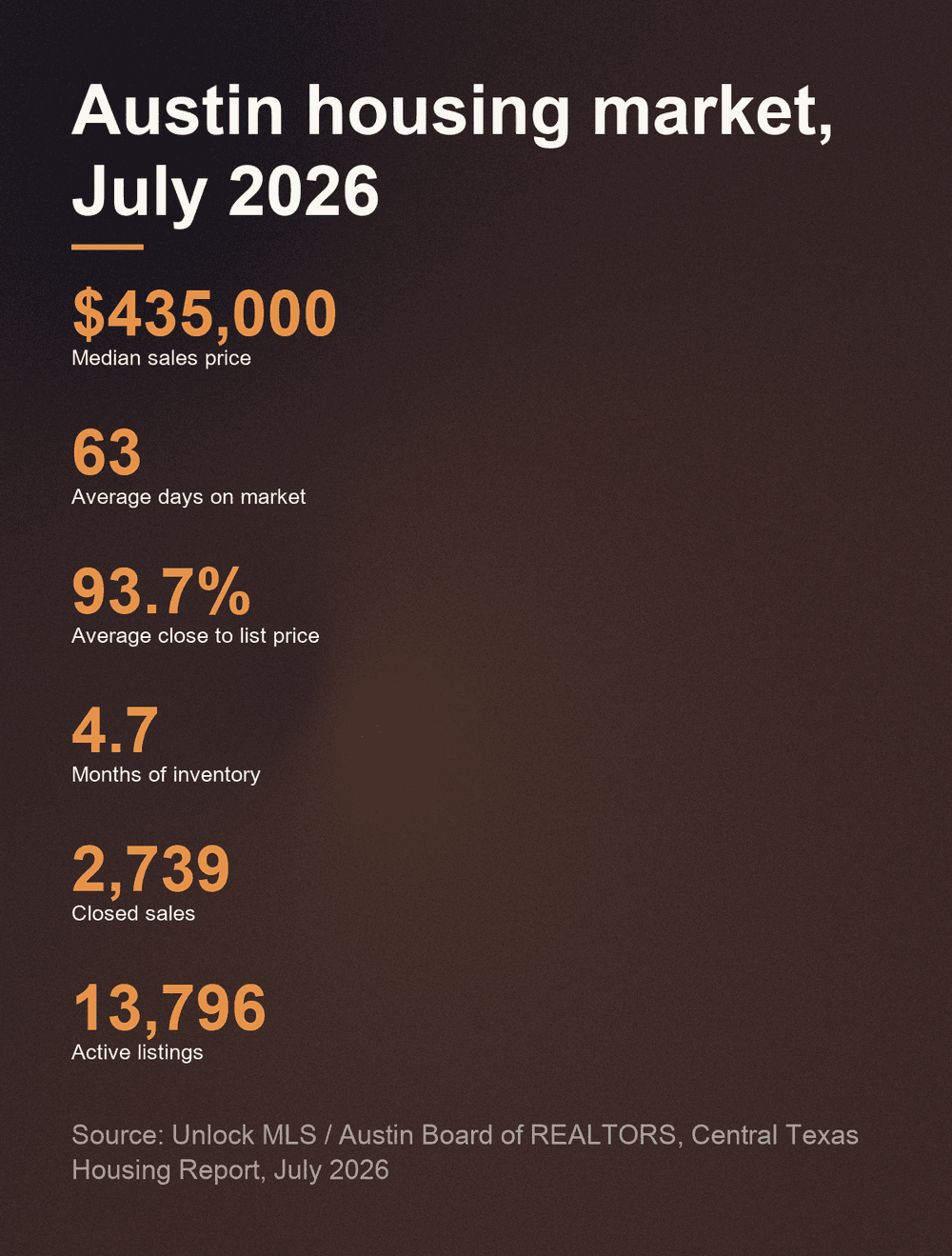
Read those together and the picture is coherent. Inventory fell almost 10% while closed sales rose 4.4%, so the backlog is clearing. Homes still take about nine weeks to sell and still trade around 6% under asking. Neither side has control.
The practical effect on financing is that appraisal gaps have mostly stopped being a thing, and seller-paid closing costs have come back into play. A seller sitting at 63 days is far more willing to contribute toward your rate buydown than a seller fielding eleven offers. Ask for it. Many buyers never do.
Which Austin neighborhoods should you look at?
Twenty communities across the metro, grouped by where they sit. Ranges below are broad bands rather than quotes, and they move. County matters more than most buyers expect, because it sets both the property tax rate and the loan limit, and those two numbers decide which programs are open to you before anything else does.
Central Austin
| Community | County | Typical range | Housing stock |
|---|---|---|---|
| Tarrytown → | Travis | $1M+ | Mid-century and traditional homes west of MoPac, minutes from downtown and Lake Austin |
| Zilker → | Travis | $1M+ | Bungalows and rebuilds beside Zilker Park and Barton Springs |
| Barton Hills → | Travis | $1M+ | 1960s ranch homes on wooded lots above the greenbelt |
| Travis Heights → | Travis | $1M+ | Older homes on hilly streets immediately south of the river |
| South Congress → | Travis | $1M+ | Small-lot homes and condos along the SoCo commercial strip |
| Northwest Hills → | Travis | $600K to $1M | Split-levels and ranch homes on steep terrain off Far West |
| Mueller → | Travis | $600K to $1M | New urbanist redevelopment of the old airport, row homes and condos, high walkability |
| East Austin → | Travis | $600K to $1M | Mix of century-old cottages and new infill construction east of I-35 |
| Allandale → | Travis | $600K to $1M | Post-war single-story homes on flat, tree-lined blocks in north central Austin |
| Hyde Park → | Travis | $600K to $1M | Historic district north of campus, Victorian and Craftsman housing stock |
West and southwest
| Community | County | Typical range | Housing stock |
|---|---|---|---|
| Steiner Ranch → | Travis | $1M+ | Master-planned community on a peninsula above Lake Austin |
| Circle C Ranch → | Travis | $600K to $1M | Large master-planned tract in southwest Austin, mostly 1990s and 2000s construction |
| Westlake → | Travis | $1M+ | Hill Country lots west of the river, wide range from teardowns to estates |
| Lakeway → | Travis | $600K to $1M | Lake Travis community, golf and waterfront inventory, many jumbo-bracket homes |
| Dripping Springs → | Hays | $600K to $1M | Acreage and newer subdivisions on the Hays County side of the Hill Country |
North, east and south corridors
| Community | County | Typical range | Housing stock |
|---|---|---|---|
| Round Rock → | Williamson | $350K to $500K | The largest suburb north of Austin, heavy 1990s through 2020s subdivision inventory |
| Georgetown → | Williamson | $350K to $500K | Historic square plus large volumes of new construction on the north edge of the metro |
| Pflugerville → | Travis | $350K to $500K | Dense suburban subdivisions between I-35 and SH 130 |
| Manor → | Travis | Under $350K | The most affordable new-construction corridor inside Travis County |
| Buda → and Kyle → | Hays | Under $350K | I-35 south corridor in Hays County, almost entirely post-2000 subdivisions |
Every community above has its own guide — tap a name for local taxes, housing stock and the loans that fit it. Ready to talk numbers now?
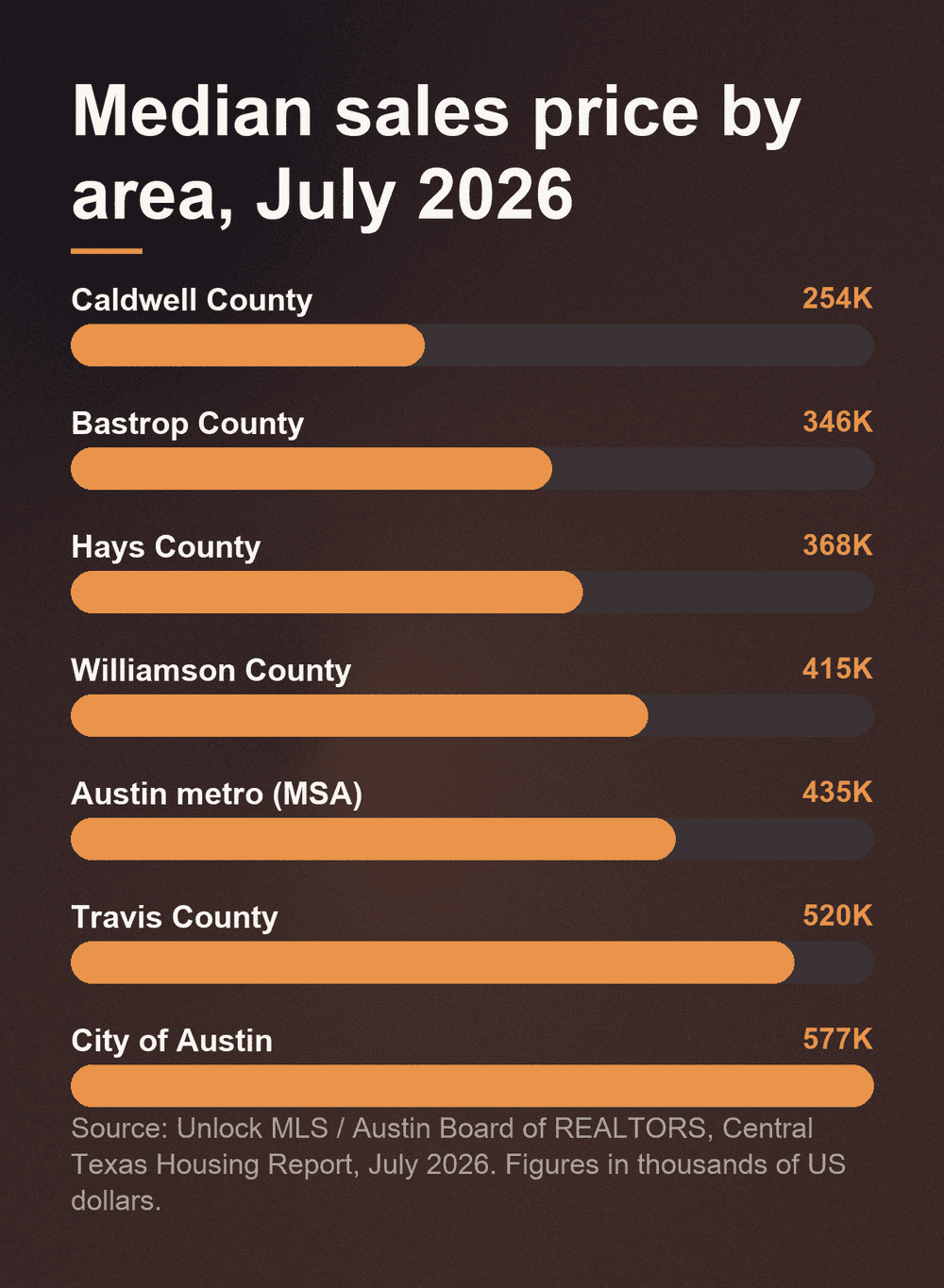
Area medians: Unlock MLS / Austin Board of REALTORS®, Central Texas Housing Report, July 2026. Community price bands are approximate and move month to month.
The bracket matters because of one number. The 2026 conforming loan limit in Travis, Williamson and Hays counties is $832,750. Below it you are in conventional territory with the widest product menu and the lowest pricing. Above it you are in jumbo, where reserves requirements tighten and fewer lenders compete. Several Austin neighborhoods sit right on that line, which is exactly where a broker earns the fee, because the jumbo panel is where pricing differences between lenders get wide.
How much are property taxes in Austin?
This is the number that catches people relocating from out of state, and it is the single most common reason an Austin pre-approval comes back lower than someone expected.
Texas has no state income tax and funds local services through property tax instead. Combined rates across the Austin metro generally land between roughly 1.8% and 2.5% of assessed value per year, depending on the city, county, school district and any municipal utility district attached to the subdivision.
On a $435,000 home at 2.1%, that is about $761 a month in tax alone, before principal, interest or insurance. Lenders count all of it in your debt-to-income ratio. A buyer moving from a state with 1% rates who budgeted on their old math will find their approval amount is materially smaller here.
Two things soften it. The Texas homestead exemption reduces the taxable value of a primary residence and caps annual assessment increases at 10% once it is in place. New subdivisions with a MUD carry an extra levy that often steps down over time as the district's debt is retired. Ask what the MUD rate is before you write an offer, because it is frequently the difference between two otherwise identical houses.
Our mortgage calculator defaults to Texas tax rates rather than the national average, which is why the payment it returns is usually higher than what a national calculator told you.
Which loan programs work best in Austin?
Everything below is available through Wise Capital Mortgage. Which one fits depends on the property, your income documentation and how long you plan to hold it.
- Conventional loans up to the $832,750 county limit, the default for most Austin purchases
- FHA loans, more forgiving on credit and debt ratios, which matters in a high-tax market where DTI is the binding constraint
- VA loans for eligible service members and veterans, with no mortgage insurance
- USDA loans, which reach further into the metro than most buyers expect. Parts of Hays, Caldwell and Bastrop counties still qualify
- Bank statement loans for self-employed borrowers whose tax returns understate their real income
- DSCR loans for rental property, qualified on the property's cash flow rather than your personal income
- Fix and flip and hard money for renovation projects on a short timeline
- Down payment assistance through TSAHC, TDHCA and City of Austin programs
What do first-time buyers in Austin qualify for?
Three assistance programs operate here and they stack differently depending on income and where you buy.
TSAHC and TDHCA are state-level and run income and purchase price limits by county. Both offer assistance structured as either a grant or a second lien, and both pair with FHA, VA, USDA or conventional first mortgages.
The City of Austin Down Payment Assistance Program applies inside city limits with its own income caps and a shared-equity or forgivable structure depending on the year's funding.
Availability changes with funding cycles and rates move with the market, so the answer to whether you qualify is a conversation rather than a page. Full detail on our down payment assistance page.
What is Austin like to live in?
Financing a house is easier when you understand what you are buying into, so here is the short version of the city itself.
Austin sits on the Balcones Escarpment, which is why the western half is hilly limestone and the eastern half is flat blackland prairie. That geology shows up in your budget. West of MoPac means slab work on rock and often a steeper lot. East means clay soil and foundation movement risk, which is worth a structural inspection.
Outdoors. Lady Bird Lake, the water in the hero video above, has a 10-mile hike and bike trail around it and no motorized boats. Barton Springs Pool runs 68 to 70 degrees year round from natural springs. The Barton Creek Greenbelt, Lake Travis, McKinney Falls State Park and the Violet Crown Trail cover most of the rest.
Music and events. Roughly 250 live music venues operate in the city. South by Southwest runs in March, Austin City Limits Music Festival takes two weekends in October, and Formula 1 races at Circuit of the Americas in the fall. All three move hotel and short-term rental demand hard, which is relevant if you are buying an investment property.
Work. Tesla, Oracle, Samsung, Apple, Dell, IBM and Applied Materials all run significant Austin operations, alongside the University of Texas and state government. Samsung's Taylor plant sits about 35 miles northeast and has pulled housing demand along the SH 130 corridor.
Getting around. I-35 splits the city north to south and is the constraint on most commutes. MoPac and SH 130 are the alternates. Austin-Bergstrom International Airport sits southeast of downtown, about 20 minutes from the center outside peak.
Weather. Summers run long and hot, with a stretch of days above 100. Winters are mild with occasional hard freezes, and the February 2021 storm is the reason Texas buyers now ask about plumbing insulation and generator readiness.
How do you choose between Austin mortgage companies?
Five questions worth asking whoever you talk to, including us.
- Are you a broker, a lender, or a bank? This determines whether your file has one shot or many.
- Who underwrites the file, and where? Local processing is faster than a file that queues in another time zone.
- What is your average days to close, and on what sample? An average without a sample size is a marketing number.
- What happens if the appraisal comes in low? A company with one investor has one answer. A broker has several.
- Can I see a full cost breakdown, not a rate? Rate alone hides points, lender fees and credits. The Loan Estimate is the comparable document.
Our NMLS ID is 2092335 and it is verifiable on the NMLS Consumer Access site, along with our license status and history. Ask any Austin mortgage company for theirs and look it up. It takes a minute.
Austin mortgage questions we get most
Who are the best mortgage companies in Austin, Texas?
Austin has roughly 200 active mortgage originators split between retail banks, direct lenders and independent brokers. The right one depends on your file. Banks and direct lenders fund their own loans and apply one set of guidelines, so a file that falls outside the box gets declined with nowhere else to go. A broker holds wholesale agreements with many lenders and moves the file to whichever one underwrites your situation. Verify any company you speak with on NMLS Consumer Access before you apply.
What credit score do you need to buy a house in Austin?
FHA loans generally start around a 580 score, conventional around 620, and VA has no published minimum although most lenders set one near 580 to 620. Score affects pricing as well as approval, so the difference between 680 and 740 shows up in what you pay rather than only in whether you qualify. Austin has no separate local requirement.
How much are property taxes in Austin?
Combined property tax rates across the Austin metro generally run between about 1.8% and 2.5% of assessed value per year, depending on city, county, school district and any municipal utility district. On a $435,000 home at 2.1% that is roughly $761 per month. Lenders include the full amount in your debt-to-income ratio, which is why Austin pre-approvals often come back lower than buyers relocating from lower-tax states expect.
What is the conforming loan limit in Austin for 2026?
The 2026 conforming loan limit for Travis, Williamson and Hays counties is $832,750 for a one-unit property. Loans above that amount are jumbo, which carry tighter reserve requirements and a smaller pool of competing lenders.
What is the median home price in Austin right now?
The median Austin-area home sold for $435,000 in July 2026, up 1.0% year over year, according to the Unlock MLS Central Texas Housing Report. The average sale closed at 93.7% of list price after 63 days on market, with 4.7 months of inventory available.
Can you get a mortgage in Austin if you are self-employed?
Yes. Self-employed borrowers whose tax returns understate their income have options beyond full documentation, including bank statement loans that qualify on deposits rather than net profit, and profit and loss based programs. These sit outside what most retail banks offer, which is a common reason self-employed Austin borrowers work with a broker.
Do USDA loans work anywhere near Austin?
Parts of Hays, Caldwell and Bastrop counties still fall inside USDA eligible areas, and the boundaries reach closer to the metro than most buyers assume. USDA offers 100% financing for eligible borrowers within income limits. Eligibility is address specific, so it is worth checking a particular property rather than ruling the program out.
How long does it take to close on a house in Austin?
Purchase contracts in the Austin market commonly run 30 to 45 days. The variables that move it are appraisal turn times, how quickly income documentation is returned, and whether the file needs manual underwriting. Ask any company for their average and the sample size behind it.
Talk to a licensed Austin loan officer
Find out what you qualify for
No cost, no credit pull to start the conversation. We will tell you which programs fit your file and what the numbers look like at today's pricing.
Wise Capital Mortgage, LLC · 5900 Balcones Drive #23333, Austin, TX 78731. NMLS #2092335. Equal Housing Lender. Licensed to originate consumer mortgage loans in the state of Texas. This page is informational and is not a commitment to lend or an offer of credit. Rates, programs and eligibility are subject to change and to underwriting approval.
Austin & Surrounding Area
Local mortgage guides for Austin and nearby
Each guide below covers one Austin neighborhood or nearby town: property taxes, what the market looks like, and the loan programs that fit. Not in the Austin area? Browse our Texas local guides for every other market we serve.
Local guides in the Austin area
Austin Neighborhoods
Austin Metro
South & Hill Country
East of Austin
Book a free call with an Austin mortgage broker
Buying, refinancing or investing in the Austin area? Pick a time and talk it through with a licensed loan officer. No obligation.
- 30 minutes, by video (Google Meet) or phone
- Free, with no obligation to apply
- A clear next step, whether that is applying now or fixing one thing first
- You talk to a licensed loan officer, not a call center
Pick a time that works for you
Choose a slot on the calendar and you will get a confirmation by email. No obligation, no pressure.
Prefer to talk now? Call 512-588-2771 · open the calendar in a new tab.