The BRRRR Method: The Margin Math, and Three Ways It Fails
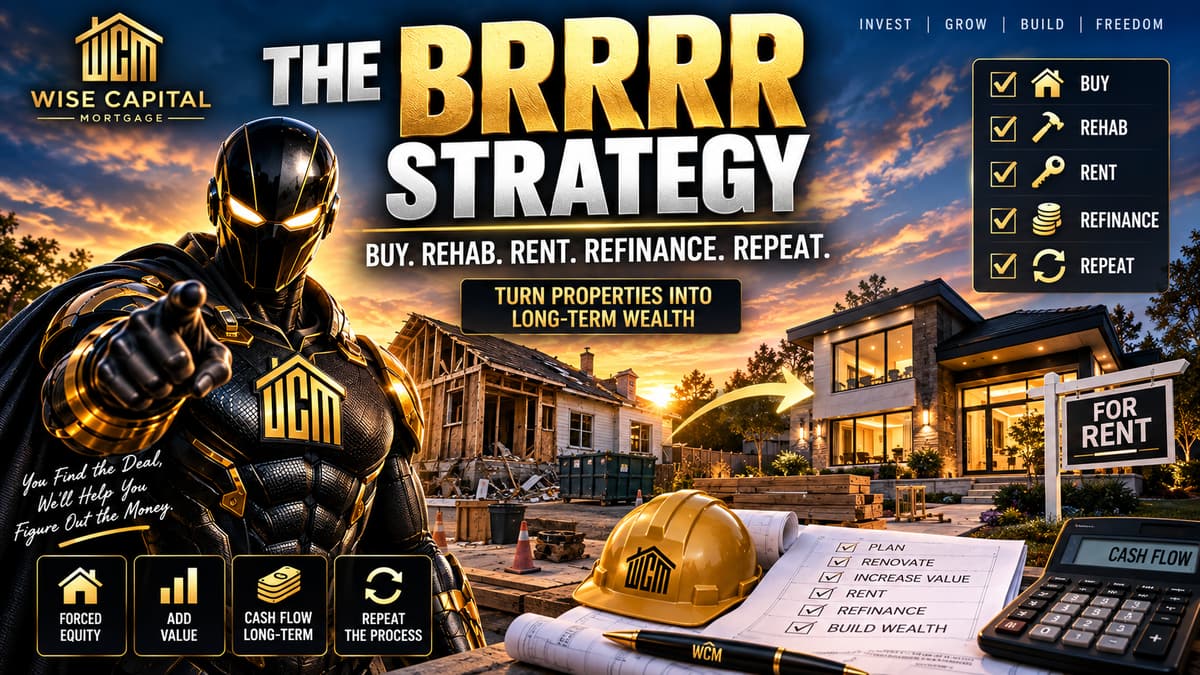
BRRRR is not a financing product. It is a bet that you can create more value than the deal costs, then borrow against the value you created.
When the bet is right, your capital comes back and you keep the asset. When it is close, you leave money trapped in a property for years. When it is wrong, you own an illiquid asset with a loan you cannot refinance.
The difference is one number, and most people never calculate it.
The mechanics: Hard money to DSCR handoff · DSCR programs
The number that decides it
To recover all your capital at refinance, this has to be true:
ARV × Refinance LTV ≥ Purchase + Rehab + Financing + Carry
At a 75% DSCR refinance LTV, that means your total all-in cost must be at or below 75% of the finished value.
Rearranged, the requirement is stark: you need at least 25% of ARV in created equity, and financing and carry eat into it before you get there.
A deal at 80% of ARV all-in leaves 5% of the value stranded. On a $400,000 property that is $20,000 you do not get back at refinance — money that sits in the asset until you sell.
That is not necessarily fatal. Leaving 5-10% in a good property is a normal outcome and still beats a conventional purchase. But it should be a decision, not a discovery.
A deal that works
| Line | Amount |
|---|---|
| Purchase | $255,000 |
| Rehab | $65,000 |
| Financing cost (points, interest, fees) | $24,000 |
| Carry (taxes, insurance, utilities, 8 mo) | $7,500 |
| All-in | $351,500 |
| Appraised value at refinance | $475,000 |
| All-in as % of ARV | 74% |
| Refinance at 75% LTV | $356,250 |
| Capital recovered | 100%, plus $4,750 |
The investor recovers everything and holds $118,750 of equity. Capital is free to redeploy.
Note the all-in landed at 74%, not the 67% the purchase-plus-rehab suggested. Financing and carry added 7 points of ARV. That is the gap investors omit.
A deal that traps capital
Same property, three ordinary things go differently.
| Line | Amount |
|---|---|
| Purchase | $255,000 |
| Rehab, 20% over | $78,000 |
| Financing, 11 months instead of 8 | $31,000 |
| Carry, 11 months | $10,300 |
| All-in | $374,300 |
| Appraisal 6% under expectation | $446,500 |
| All-in as % of ARV | 84% |
| Refinance at 75% LTV | $334,875 |
| Capital left in the deal | $39,425 |
A 20% rehab overrun, three extra months, and a 6% appraisal miss. None unusual. The investor now has $39,425 trapped, and the next deal is not happening this year.
The property is still fine — $111,625 of equity, cash flowing. But the strategy failed, because the point of BRRRR is capital velocity and the capital did not come back.
Illustrative. Costs, values and terms vary.
The three failure modes
1. The appraisal comes in under
The most common. You need the appraiser to see the value you believe you created, and the appraiser values against neighborhood comps, not your receipts.
Why it happens: over-improving for the block, thin comps, unpermitted square footage excluded, or a market that softened during your rehab.
Defenses: model ARV from closed comps at the conservative end. Pull permits. Match the finish level to what actually sold nearby. How ARV is determined and contested.
2. The clocks do not line up
Your hard money matures before the DSCR lender will use the improved value.
Seasoning is commonly 6-12 months before appraised value replaces purchase price. A 9-month hard money term against a 12-month seasoning requirement is a structural failure you cannot fix at month eight.
Defense: confirm the takeout lender's seasoning and lease requirements before you close the acquisition loan, and size the hard money term to fit with 90 days of buffer. The handoff timeline.
3. The ratio does not support the refinance
The property appraised fine, but rent does not cover the new payment at the loan size you need.
This is the Central Texas failure specifically. High property taxes sit in PITIA, and a larger refinance means a larger payment. You can appraise at $475,000 and still fail a 1.00 DSCR floor. Why Austin ratios run tight.
Defense: model the refinance DSCR at the target loan amount before you buy — not the purchase DSCR, the refinance DSCR. They are different numbers and the second one is what matters.
What makes a BRRRR deal work
Five conditions, and you want most of them:
1. A genuine discount at purchase. BRRRR runs on forced appreciation. Buying at market and renovating rarely produces 25% of created equity — you are spending a dollar to make a dollar.
2. Rehab that adds more value than it costs. Kitchens, baths, curb appeal, adding a bedroom where the layout allows. Foundation work and system replacement are often necessary and rarely add proportional value.
3. Rent that supports the refinance payment. Check this at the target loan amount before you buy.
4. Timeline discipline. Every month of overrun is interest, taxes, insurance and utilities. Three extra months on a $300,000 balance is roughly $10,000.
5. Contingency you actually keep. 15-20%, not deleted to make the model work.
Does BRRRR still work
Yes, and it is harder than it was in the years when appreciation did half the job.
What changed: entry prices rose faster than rents in most Sun Belt markets, financing costs are higher than the last cycle, and insurance has moved sharply in Texas. All three compress the spread.
What did not change: the arithmetic. If you buy at a real discount, renovate to a standard the market pays for, and keep the timeline tight, the capital comes back.
The honest adjustment is that marginal deals no longer work. In a market where everything appreciated 15% a year, a mediocre BRRRR was rescued by the market. Now it is not. The deals that work are the ones that worked on paper before any appreciation assumption.
BRRRR versus flipping the same property
| BRRRR | Flip | |
|---|---|---|
| Capital returned | Most or all, at refinance | All, plus profit, at sale |
| You keep the asset | Yes | No |
| Tax treatment | No taxable event at refinance | Ordinary income at sale |
| Ongoing income | Rent | None |
| Timeline to capital | 8-14 months | 5-9 months |
| Risk | Appraisal, ratio, seasoning | Appraisal, market, timeline |
The tax difference is larger than people expect. A refinance is not a taxable event. A flip generates ordinary income, often with self-employment tax. Why flips are taxed as dealer income.
On the same property, BRRRR frequently produces a better after-tax outcome even when the flip shows a bigger headline number.
Frequently asked questions
What is the BRRRR method? Buy, rehab, rent, refinance, repeat. Acquire and renovate with short-term financing, stabilize with a tenant, refinance into long-term debt, and redeploy the recovered capital.
How much equity do I need to create? At a 75% refinance LTV, your all-in cost must be at or below 75% of ARV to recover everything — roughly 25% of created equity, with financing and carry counted.
Why do BRRRR deals fail? A low appraisal, a seasoning mismatch between the acquisition loan and the refinance, or a DSCR that will not support the refinance payment.
How long does a BRRRR take? Commonly 8-14 months from purchase to refinance, driven mostly by rehab time and the refinance seasoning requirement.
Can I do BRRRR with no money down? Not realistically. You need the down payment, the draw float, carry and contingency. The capital comes back at refinance, it is not absent at the start.
Is BRRRR better than flipping? Different. BRRRR keeps the asset and avoids a taxable event; flipping returns capital faster but generates ordinary income. After tax, BRRRR often wins on the same property.
Does BRRRR still work in 2026? Yes, on deals with a genuine purchase discount. Marginal deals that appreciation used to rescue no longer work.
Next steps
Calculate all-in cost as a percentage of ARV — including financing and carry — before you buy. Under 75% and the capital comes back. Over 80% and you are buying a rental with extra steps.
Have a deal you want looked at?
Send the property and the numbers — we shop it across lender programs and tell you honestly whether it works.
Talk To A Loan OfficerRelated Reading
Educational content, not a commitment to lend or an offer of credit. DSCR and fix-and-flip loans are business-purpose loans secured by non-owner-occupied property. Program parameters vary by lender and change over time. Figures are illustrative.