Fix and Flip in an LLC: Dealer Status and the Tax Problem
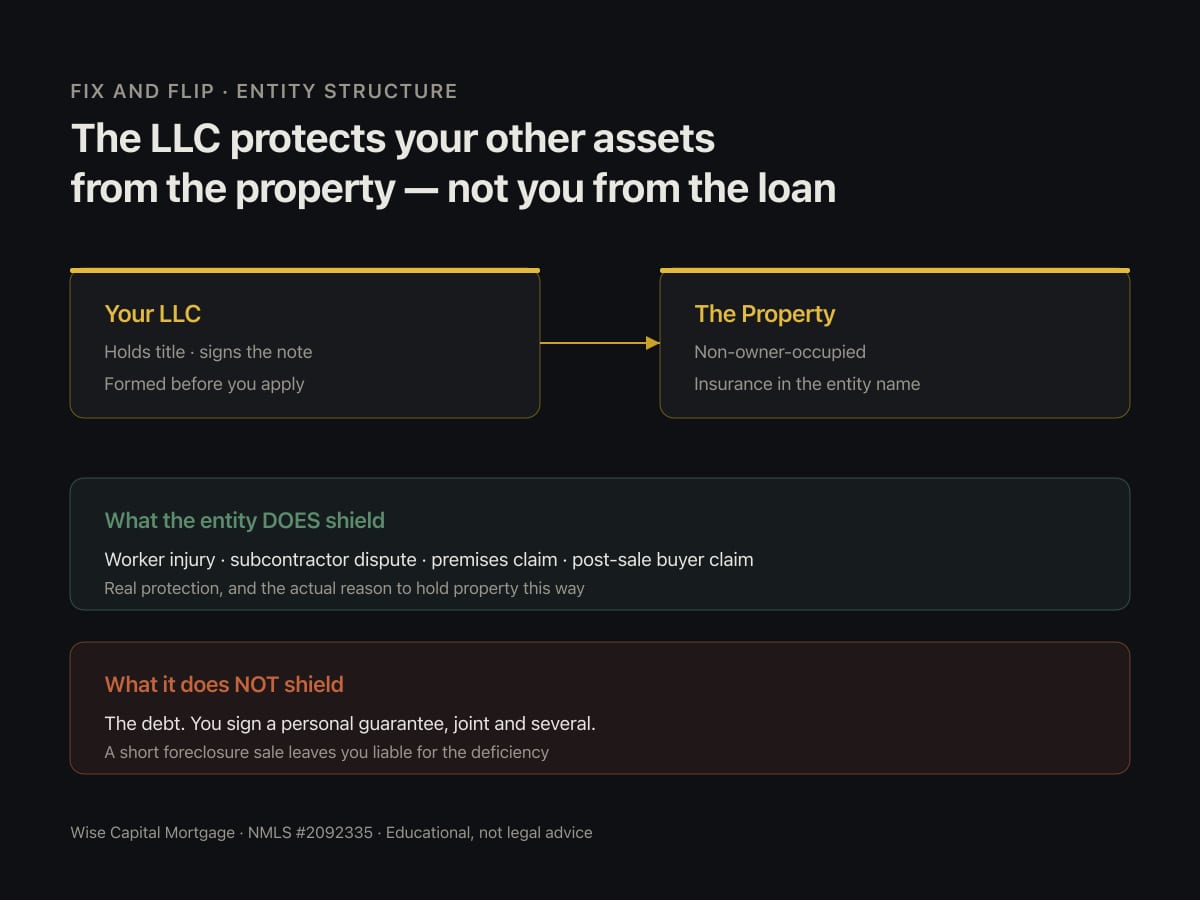
For the loan, an LLC is simple — hard money lenders expect entity vesting and most require it.
For taxes, flipping in an entity is a genuinely different situation from holding rentals in one, and the difference costs money. Investors who set up a flip entity the way they set up a rental entity frequently get a surprise at filing.
Programs: Fix and flip financing · Underwriting requirements
The lending side, briefly
Straightforward.
Entity vesting is standard. Hard money is business-purpose lending. LLC, LP and corporation all work, and many lenders require an entity rather than merely permitting one.
You will personally guarantee it. The entity holds title and signs the note; you stand behind it. If a foreclosure sale falls short, the lender can pursue you for the deficiency.
What the LLC does protect is the other direction — liability arising from the project. A worker injury, a subcontractor dispute, a claim from a buyer after the sale. Those stay with the entity, and on a construction project that exposure is real.
Documentation needed: Certificate of Formation, signed Operating Agreement, EIN letter, recent Certificate of Good Standing, and a borrowing resolution. Form the entity before you apply — some lenders want it in existence 30 days. Full entity mechanics.
The tax side, which is the real subject
Here is where flipping diverges sharply from holding.
Dealer status
The IRS distinguishes between property held for investment and property held primarily for sale to customers in the ordinary course of business. The second makes you a dealer, and flips generally fall there.
The consequences are significant:
| Investor (rental) | Dealer (flipper) | |
|---|---|---|
| Gain treatment | Capital gain | Ordinary income |
| Long-term rates available | Yes, after 12 months | No |
| Self-employment tax | No | Often yes |
| 1031 exchange eligible | Yes | No |
| Depreciation | Yes | No — it is inventory |
| Installment sale treatment | Available | Generally not |
The two that hurt most:
No long-term capital gains treatment. Even if you hold a flip for fourteen months, dealer property does not get the preferential rate. The holding period does not rescue you.
No 1031 exchange. You cannot defer a flip gain into the next property. This surprises people constantly — the 1031 is for investment property, and dealer inventory does not qualify.
Self-employment tax may apply on top of income tax, depending on your structure and how the activity is characterized.
What determines dealer status
There is no bright line. The IRS and courts weigh factors including:
- Frequency and number of sales
- Intent at acquisition
- Extent of improvement activity
- How you market the property
- Whether it is your primary occupation
- Holding period
One flip in a year while you work full time elsewhere looks different from twelve flips a year. But intent at acquisition matters more than volume, and "I intended to rent it but sold it" is a position you need contemporaneous facts to support.
This is genuinely a CPA question, and it is worth asking before your first flip rather than at your first filing.
Structure choices and why they differ from rentals
For rentals, an LLC taxed as a partnership or disregarded entity is usually the default and usually right.
For flips, the analysis changes because of self-employment tax.
LLC taxed as a disregarded entity or partnership — simplest. Income flows to your return. On dealer activity, that income may be subject to self-employment tax in full.
LLC with an S-corporation election — the structure many active flippers use. It allows you to pay yourself a reasonable salary subject to employment taxes and take remaining profit as a distribution not subject to self-employment tax.
The savings can be meaningful at volume. The costs are real too: payroll administration, a separate return, reasonable-compensation rules the IRS enforces, and complications if you also hold rentals in the same entity.
The common structure for investors doing both: a separate entity for flips, often with an S-election, and separate entities for long-term rentals taxed as partnerships or disregarded. Mixing dealer activity and investment property in one entity can taint the investment property's treatment.
Talk to a CPA before forming anything. This paragraph is the outline of a conversation, not the answer to it. The right structure depends on your volume, your other income, your state and your plans.
Practical requirements
Separate bank account. Non-negotiable. All project funds in and out of the entity account. Commingling is the standard argument for piercing the corporate veil, and lenders want to source funds from an account clearly belonging to the borrower.
Insurance in the entity name. Builder's risk or vacant dwelling policy with the LLC as named insured. A policy in your personal name on entity-owned property can fail to pay.
General liability, and verify your contractor's. Construction activity carries injury exposure that a landlord policy does not contemplate. Collect certificates of insurance from every contractor and verify them directly with the carrier.
Contractor agreements in the entity name. Contracts, invoices and payments all through the entity, matching the name on the Secretary of State record exactly.
1099s. You will likely need to issue them to contractors. Collect W-9s as you engage people, not in January.
One entity or several
One flip entity, sequential projects — simplest, and fine when you run one or two projects at a time. Exposure from a completed project can reach a current one, but the window is limited.
Separate entity per project — maximum isolation, meaningful cost and administrative overhead. Worth it on large projects or when running several simultaneously.
Series LLC — Texas recognizes them and they are popular here. Lender acceptance for hard money varies; confirm before forming.
Most investors start with one entity and add separation as project size and volume grow.
Frequently asked questions
Do I need an LLC to flip houses? For hard money financing, usually yes — entity vesting is standard and many lenders require it.
Will I still personally guarantee the loan? Almost always. The entity holds title, you guarantee the note.
Are flip profits taxed as capital gains? Generally no. Flips typically generate dealer income, taxed as ordinary income regardless of holding period, and often subject to self-employment tax.
Can I 1031 exchange a flip? Generally not. Dealer property held primarily for sale does not qualify for 1031 treatment.
Should my flip LLC elect S-corp status? Many active flippers do, for the self-employment tax treatment. It adds payroll and compliance obligations. This is a CPA decision based on your volume and income.
Can I hold flips and rentals in the same LLC? Usually inadvisable. Dealer activity can complicate the tax treatment of investment property held alongside it. Most investors separate them.
Does the LLC need history to get a loan? No. Underwriting looks at the members' credit, liquidity and experience. A newly formed entity is fine, though some lenders want 30 days of existence.
Next steps
Talk to a CPA about dealer status and entity structure before your first project, not after. The lending side is simple; the tax side is where the money is.
Have a deal you want looked at?
Send the property and the numbers — we shop it across lender programs and tell you honestly whether it works.
Talk To A Loan OfficerRelated Reading
Educational content, not a commitment to lend or an offer of credit. DSCR and fix-and-flip loans are business-purpose loans secured by non-owner-occupied property. Program parameters vary by lender and change over time. Figures are illustrative.