How to Calculate DSCR (And What Lenders Do Differently)
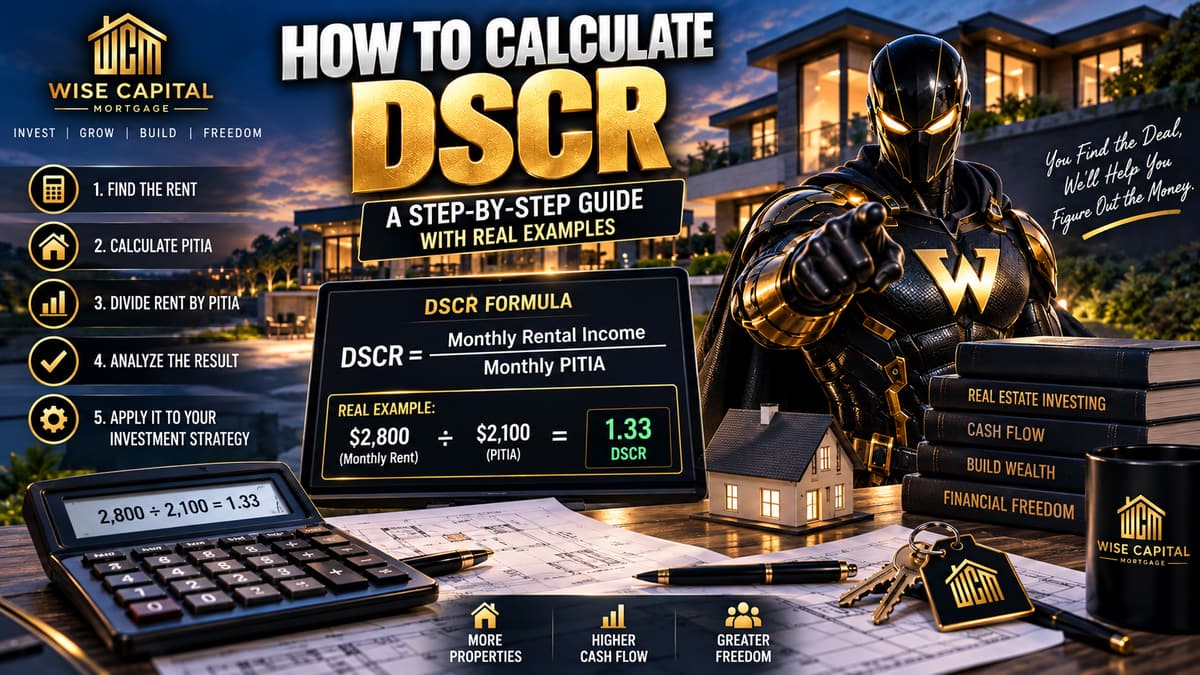
The formula takes ten seconds. The disagreements take deals apart.
Most investors calculate a ratio, feel good about it, and then watch the lender come back with a lower number. The formula was not wrong. The inputs were — because lenders define four of them differently than investors do.
Here is the math, then the four places it diverges.
Run your own numbers: DSCR calculator and payment tool · DSCR loan programs
The formula
DSCR = Gross Monthly Rent ÷ Monthly PITIA
PITIA is principal, interest, taxes, insurance, and HOA dues if the property has them.
Worked:
| Input | Amount |
|---|---|
| Gross monthly rent | $2,800 |
| Principal & interest | $1,620 |
| Property taxes (monthly) | $560 |
| Insurance (monthly) | $145 |
| HOA | $0 |
| PITIA | $2,325 |
$2,800 ÷ $2,325 = 1.20 DSCR
That is it. No vacancy factor, no maintenance reserve, no management fee, no depreciation. The lender's ratio is deliberately cruder than your pro forma.
What a given ratio means
| DSCR | Reading |
|---|---|
| 1.25+ | Best pricing tier |
| 1.00-1.24 | Standard approval range |
| Exactly 1.00 | Rent equals payment. Break-even before any expense you actually have. |
| 0.75-0.99 | Approvable on some programs at reduced leverage and higher cost |
| Under 0.75 | Generally declined outside no-ratio programs |
A 1.00 DSCR is not a break-even property. It is a break-even loan payment. Vacancy, turnover, repairs, management and capital expenditure all sit outside the formula and all come out of your pocket. A property at exactly 1.00 loses money in any month something breaks.
The four places lenders disagree with you
1. They use gross rent, not your net
You model $2,800 rent, 6% vacancy, 8% management, $150 maintenance — and call it $2,250 net.
The lender uses $2,800.
This works in your favor for qualifying and against you for judgment. The ratio that approves your loan is not the ratio that tells you whether the deal is good. Run both. Never let the lender's number stand in for your own underwriting.
2. They may not use the rent you think
Three methods, depending on the property:
Leased long-term rental — the lender compares your executed lease against a Form 1007 market rent schedule prepared by the appraiser. Many programs use the lower of the two.
That matters. If you inherited a tenant at $3,100 and the appraiser says market is $2,700, a good number of lenders qualify you at $2,700. Your actual cash flow is better than your qualifying ratio. Underwriting does not care.
Vacant at closing — the 1007 carries the file alone. You are qualifying on an appraiser's opinion, which is why a low 1007 can sink a deal that looked fine.
Short-term rental — the widest variation in DSCR lending. Programs use trailing 12-month platform revenue, or a third-party market estimate, or actual revenue with a 20-30% haircut for vacancy and management. Some will not lend on STR at all. The STR specifics are their own subject.
Related-party leases get scrutinized. Renting to a family member at an above-market rate usually gets thrown out in favor of the 1007.
3. They use their payment, not your estimate
Your P&I estimate assumes a rate. The lender's assumes the rate your file actually prices at — after the credit, LTV, purpose, property type and prepay adjustments stack up.
This is circular and it catches people. A weaker file gets a higher rate, which raises the payment, which lowers the DSCR, which can push you into a worse pricing tier, which raises the rate again. Files near a ratio boundary can spiral.
The defense is to model with a conservative rate, not an optimistic one. If you are quoted a range, use the top of it.
4. Taxes are the input everyone gets wrong
This is the big one, and in Texas it is enormous.
Use the post-sale assessed value, not the seller's tax bill. A sale resets the appraisal district's basis. If the seller has owned since 2015, their assessed value may be far below what you will pay, and their tax bill is not the one you will get.
Travis, Williamson and Hays counties run roughly 1.8-2.2% effective. On a $400,000 purchase that is $7,200-$8,800 a year — $600-$733 a month sitting in the denominator.
Model it wrong by $200 a month and a 1.12 ratio becomes 1.03. That is a pricing tier, and sometimes an approval.
Also: if the seller holds a homestead or over-65 exemption, those do not transfer to you. An investment property gets no homestead cap. The jump can be severe.
Stress-testing
One ratio is not an answer. Move each input against you and see what survives.
Base case: $2,800 rent, $2,325 PITIA, 1.20 DSCR.
| Scenario | Rent | PITIA | DSCR |
|---|---|---|---|
| Base | $2,800 | $2,325 | 1.20 |
| 1007 comes in 8% under lease | $2,576 | $2,325 | 1.11 |
| Taxes reassess 15% higher | $2,800 | $2,409 | 1.16 |
| Insurance up 20% | $2,800 | $2,354 | 1.19 |
| Rate 0.5% higher | $2,800 | $2,430 | 1.15 |
| All four together | $2,576 | $2,538 | 1.01 |
A deal that looked like a comfortable 1.20 is a 1.01 when four ordinary things go mildly wrong at once. None of those four are disaster scenarios — a slightly low 1007, a reassessment, a Texas insurance increase and half a point of rate are all normal.
If the stressed case is under 1.00, you do not have a 1.20 deal. You have a 1.20 deal in good conditions.
Illustrative. Your inputs will differ.
Raising the ratio
In order of how much they move it:
- More down. Directly lowers P&I. On the numbers above, going from 75% to 70% LTV raises the ratio roughly 0.08.
- Buy at a better rent-to-price. The structural fix. A property renting at 0.8% of purchase price monthly behaves completely differently than one at 0.55%.
- Improve your pricing tier. A better credit tier lowers the rate, lowers the payment, raises the ratio. Credit tiers here.
- Shop insurance properly. A $60/month difference is 0.03 on the ratio. Get real quotes at offer, not at underwriting.
- Protest the assessment. Texas lets you protest annually. It will not help at closing, but it compounds over the hold.
- Avoid HOA property where the ratio is tight. HOA dues sit fully in PITIA and return nothing to the numerator.
What does not work: signing a lease above market to inflate the numerator. The 1007 catches it, and a non-arms-length lease raises a fraud question rather than a ratio.
DSCR on 2-4 units
Add the units. A duplex at $1,450 and $1,500 is $2,950 gross.
Two adjustments matter:
- Vacancy hits harder per unit but less often overall. One vacancy in a duplex is 50% of income; one in a fourplex is 25%. Lenders do not model this, but you should.
- Some programs use only leased units on a partially vacant property, with the 1007 covering the rest. A fourplex with two vacancies can qualify lower than you expect.
Frequently asked questions
What is a good DSCR? For pricing, 1.25+. For approval, 1.00+. For an actual business, comfortably above 1.20 — because the formula ignores vacancy, repairs and management.
Does DSCR use gross or net rent? Gross. No vacancy or expense deductions. That is why the lender's ratio is not a measure of whether the deal is good.
Is HOA included in DSCR? Yes — the A in PITIA. It is a common omission and it goes straight to the denominator.
What if my DSCR is below 1.00? Some lenders go to 0.75 with more down and higher pricing. Below that, look at no-ratio programs or a different property.
Can I use projected rent on a vacant property? Not your projection — the appraiser's Form 1007 market rent schedule.
Does DSCR include vacancy? No. Neither vacancy nor maintenance nor management. Model those separately in your own numbers.
How do lenders calculate DSCR on a short-term rental? It varies more than any other input — trailing platform revenue, third-party estimates, or actual revenue with a haircut. Confirm the method before you go under contract.
Next steps
Run the base case, then run it stressed. If the stressed version is under 1.00, price the deal off the stressed version.
Have a deal you want looked at?
Send the property and the numbers — we shop it across lender programs and tell you honestly whether it works.
Talk To A Loan OfficerRelated Reading
Educational content, not a commitment to lend or an offer of credit. DSCR and fix-and-flip loans are business-purpose loans secured by non-owner-occupied property. Program parameters vary by lender and change over time. Figures are illustrative.